
Are you a property owner? New reforms and obligations for the EPC in 2025
This article helps you understand whether your current EPC is still valid, the new obligations to come and the importance of collective EPCs for co-ownerships
The Energy Performance Certificate (EPC) is an essential tool for assessing the energy consumption and greenhouse gas (GHG) emissions of a dwelling.
Rating buildings from A to G, it has become a decisive criterion for the sale or letting of a property, especially in the context of recent reforms aimed at reducing "energy sieves" (dwellings rated F and G).
EPCs carried out before 2021: Why do they need to be redone?
The 2021 EPC reform introduced a unified calculation method, the 3CL method (Calcul de la Consommation Conventionnelle des Logements), making the results more reliable and transparent. This new calculation is based on the technical characteristics of the dwelling (insulation, heating, ventilation, etc.) instead of the consumption habits of the occupants.
EPCs carried out before this reform were often based on consumption estimates that varied according to the occupants, which made them less reliable for objectively comparing energy performance.
With the 2021 reform, the EPC now incorporates GHG emissions in addition to energy consumption, providing a more complete view of the environmental impact of dwellings.
EPCs carried out before July 2021 must therefore be renewed before 1 January 2025 to reflect this new methodology.
Also, the EPC is now a legally binding document, which means that buyers and tenants can take legal action if the diagnostic is erroneous or misleading. Owners must therefore provide an accurate and compliant EPC, failing which they risk financial compensation claims.
Collective EPCs: an obligation for buildings held in co-ownership
Since 1 January 2023, collective buildings of more than 16 lots built before 2013 and with collective heating must carry out a collective EPC. From 1 January 2025, this obligation will extend to all co-ownerships. This diagnostic allows an overall assessment of the building's energy performance, making it easier to plan energy improvement works for the co-ownerships concerned.
The collective EPC is a response to the objectives set by the Energy and Climate Act of 2019 and the Climate and Resilience Act of 2021. These laws aim to reduce buildings' CO₂ emissions by 2050, by imposing progressive obligations on owners and co-owners to encourage energy renovations and reduce energy consumption.
Consequences for co-owners
A collective EPC allows co-owners to see the energy weaknesses of their building (insulation, heating, ventilation, etc.). This transparency makes renovation decisions easier at general meetings and makes it possible to anticipate future restrictions on the letting of energy-intensive properties. Dwellings rated F or G may be subject to penalties, limiting their letting and sale potential. This is already the case with dwellings rated G, which have been banned from increasing their rents since 2021 and which will be banned from letting from January 2025. Dwellings rated F, for their part, will have a little more time with a letting ban in 2028. A good EPC rating increases their value and their appeal on the property market.
EPC Standards and Regulations
Current standards
The 3CL method introduced in 2021 aims to standardise the EPC calculation and to offer a more reliable diagnostic. It is based on standardised criteria independent of the occupants' habits, incorporating thermal losses, heating, hot water, air conditioning, and lighting. The A-to-G classification thus allows a precise assessment and an objective comparison between dwellings.
Since this reform, every EPC must be included in the sale or letting file before a property is advertised. In addition to being a decision-making criterion for buyers or tenants, it is now legally binding, making owners responsible for the information provided.
Future standards
From 2025, dwellings rated G can no longer be let, and this restriction will be extended to dwellings rated F from 2028. Owners will then have to plan renovation works to escape these bans. For the sale of dwellings (detached houses or single-owner buildings) rated F or G, an energy audit will also be mandatory in order to inform potential buyers of the works required and the associated costs.
The multi-year works plan (PPT) to postpone the letting ban?
A PPT allows co-ownerships to benefit from a postponement of the letting ban for energy-intensive dwellings.
The main objective is to authorise a temporary postponement of the letting ban for energy-intensive dwellings. Indeed, without this postponement, the law progressively bans the letting of dwellings rated F and G, as part of the fight against energy sieves. Co-ownerships that wish to continue letting these properties must therefore:
- Present a PPT containing a clear timetable of renovation works aimed at improving energy performance, voted at a general meeting by the co-owners.
- Undertake steps to carry out insulation works, heating renovation, or energy compliance works in order to move out of energy classes F and G.
These measures apply throughout the whole of France and concern all co-ownerships with dwellings rated as energy-intensive, whatever their location (urban, peri-urban, or rural).
France has set itself a general objective of carbon neutrality by 2050, which means that co-ownerships must plan and carry out the necessary renovations well before this deadline.
The law has provided for a progressive ban on letting energy-intensive dwellings: the most energy-intensive dwellings, that is to say those rated G, will no longer be authorised for letting from 2025, followed by those rated F in 2028.
The objectives of this measure are manifold:
- Reduce the carbon footprint of dwellings by decreasing the greenhouse gas emissions coming from poorly insulated buildings.
- Ensure a more sustainable and better-performing housing stock, contributing to the achievement of France's climate objectives.
- Protect tenants by guaranteeing decent living conditions and a reduction in energy costs.
- Encourage the renovation of the housing stock and prompt co-owners to invest in renovations that will improve the value of their property in the long term.
The Property Decree: A strengthened framework for Property Ownership
The property decree governs the rights and obligations of owners of dwellings rated F and G in order to prompt them to improve their energy efficiency. For example, owners of energy-intensive dwellings can no longer increase rents until the renovation works have been carried out. This decree aims to ensure that let dwellings offer a minimum threshold of energy performance.
Owners can, however, access support such as MaPrimeRénov' and the Energy Saving Certificates (CEE) to ease the cost of renovations. In a co-ownership, a PPT can be adopted to spread the works over time and obtain a period for compliance. Owners also retain the right to contest EPC assessments in the event of errors or inaccuracies.
Penalties for non-compliance
Owners are exposed to various financial penalties in the event of non-compliance with the renovation obligations. These include the freezing of rents for dwellings rated F and G, the ban on letting for class G from 2025, compensation for tenants, and legal recourse for buyers and tenants in the event of a dispute over energy compliance.
Conclusion
In summary, the EPC reform and the new regulations in force aim to transform the French housing stock to make it more energy-efficient and environmentally friendly. Owners are therefore faced with several important deadlines:
- 2025: Letting ban for dwellings rated G.
- 2028: Extension of the letting ban to dwellings rated F.
- 2050: Carbon neutrality objective for the entire housing stock.
Faced with these deadlines, it is essential for owners to anticipate by carrying out the diagnostics now and by planning the necessary renovation works. Several forms of financial support, such as MaPrimeRénov' and the CEE, are available to facilitate this energy transition and ease the financial burden of the works.
This transition, although demanding, represents an opportunity for owners to increase the value of their properties while contributing to national efforts to combat climate change. Preparing now will make it possible to avoid future penalties and to adapt to the requirements of this market as it shifts towards more sustainable and energy-efficient dwellings.
Related diagnostic
EPC (Energy Performance Certificate)
A property project? Get a quote for your diagnostics.
Related articles

Co-ownerships: the collective EPC mandatory since 2025
Since 1 January 2025, co-ownerships are required to have an up-to-date collective energy performance certificate (EPC). In this article, we help you fully understand what the collective EPC is and what is at stake with this new regulation.
Read more →
Electricity coefficient in the EPC: what the shift from 1.9 to 1.7 will change in 2027
The electricity coefficient used in the French energy performance certificate (EPC) will drop from 1.9 to 1.7 on 1 January 2027. Here is an overview of the homes affected, the possible impact on the EPC rating and the steps to anticipate.
Read more →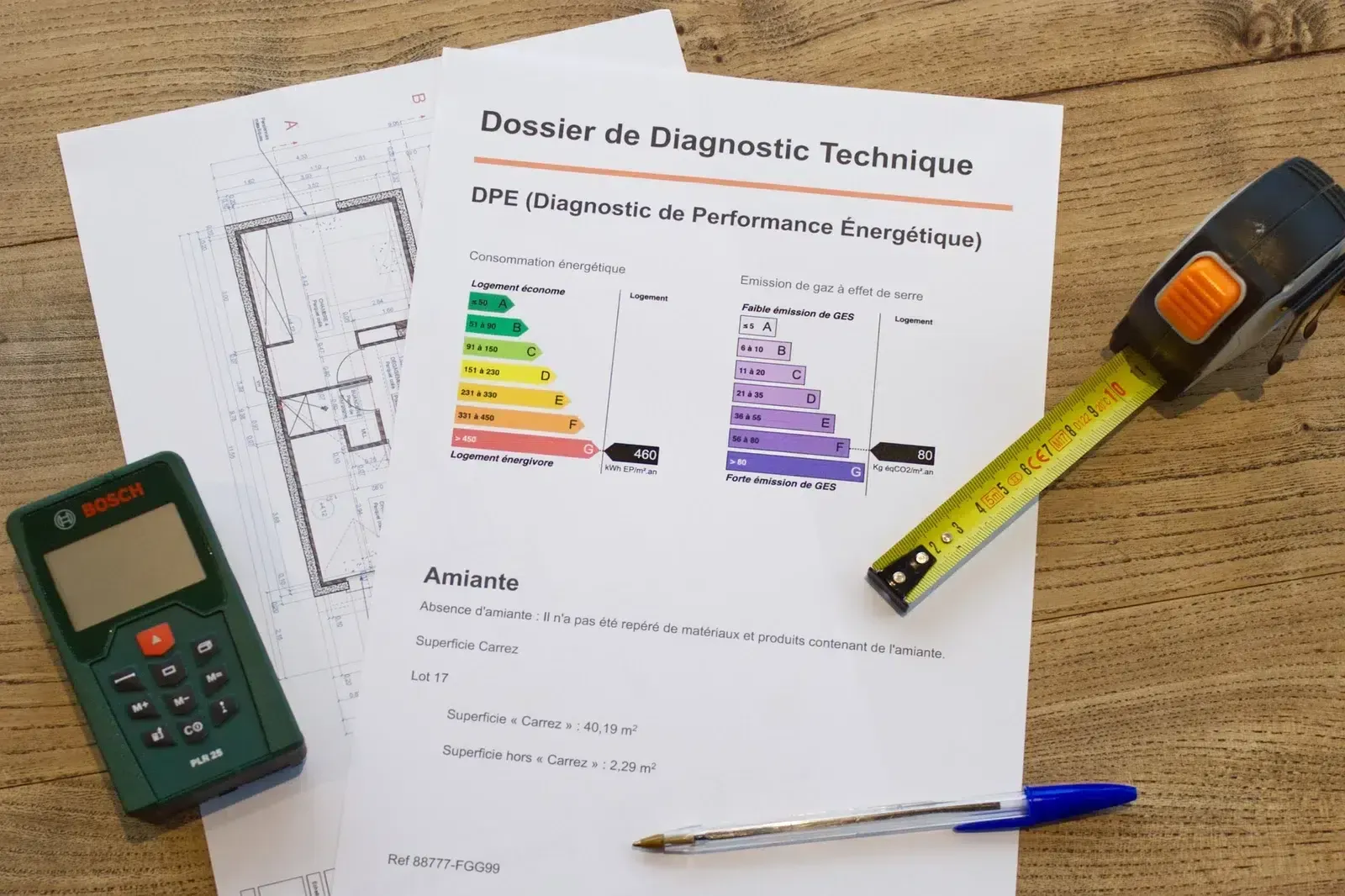
I use little energy but have a poor EPC – how is that possible?
Unfortunately, you are not the only ones facing this situation. To better understand this paradox between consumption and EPC rating, RITMODiag explains everything!
Read more →