
Co-ownerships: the collective EPC mandatory since 2025

Since 1 January 2025, co-ownerships are required to have an up-to-date collective energy performance certificate (EPC). In this article, we help you fully understand what the collective EPC is and what is at stake with this new regulation.
Everything you need to know about the collective Energy Performance Certificate in co-ownership
The collective EPC is a property diagnostic carried out collectively. It has existed for several years, but its regulations have evolved over the years.
Today, energy performance issues are becoming central to the property and diagnostics sector. The collective energy performance certificate examines the consumption, heat losses and equipment of an entire co-ownership, thereby making it possible to identify a building’s energy performance, energy consumption and greenhouse gas emissions. Unlike an individual EPC that focuses on a single dwelling, the mandatory collective EPC covers the entire co-ownership.
The results of this diagnostic thus reveal whether a co-owned building, including the dwellings and communal areas, is energy-intensive or not, via a rating ranging from G (for the most energy-intensive) to A (for the most efficient), and thereby identify the weak points in terms of insulation, heating or ventilation.
But why has this diagnostic become so widespread in today’s property landscape?
For several years now, in France in particular, it has become crucial to focus on reducing our greenhouse gases, and the property sector is no exception!
The « Climate and Resilience » law (2021) seeks to promote a better energy transition and the energy renovation of the entire housing stock. It thus sets out a timetable to progressively make various diagnostics mandatory, extending to more and more buildings.
The obligations in force since 2025
The obligation for the collective EPC stems from the « Climate and Resilience » law. This obligation is being strengthened over the years in order to reduce the carbon footprint and to combat energy performance losses across a greater number of co-ownerships.
Which co-ownerships are affected by the collective EPC?
Would you like to know whether you are required to have a collective Energy Performance Certificate carried out and to call on a property surveyor?
The collective EPC was made mandatory in 2024 for single-ownership and
co-owned buildings of more than 200 lots whose planning permission was filed before 1 January
2013.
But the scope of this diagnostic is changing, and since 1 January 2025, this obligation extends to co-ownerships of between 50 and 200 lots.
In the future, the obligation for a collective EPC is set to become widespread, and the following milestones are planned in the « Climate and Resilience » law’s timetable:
- 1 January 2026: for co-ownerships of fewer than 50 lots,
- 1 January 2028: obligations extended to Guadeloupe, French Guiana, Réunion and Mayotte.
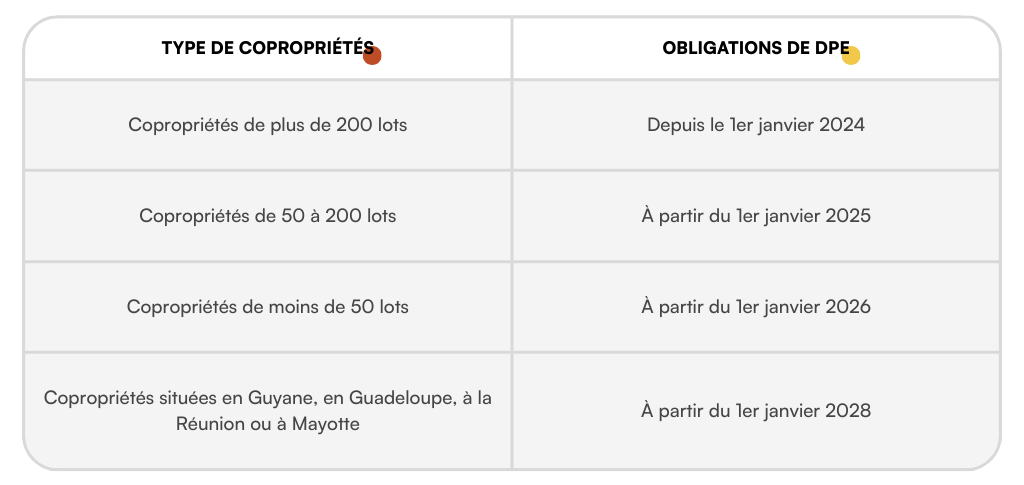
This timetable is part of the « Climate and Resilience » law’s initiatives and thus aims to accelerate the renovation of the housing stock. It also helps to better inform co-owners about the actual performance of their building and aims to facilitate the implementation of comprehensive renovation works.
The gradual expansion of the scope is part of an effort to combat energy sieves. Indeed, poorly rated dwellings (F or G) are becoming banned from sale or let.
The collective EPC is also a genuine consideration for the approval of a mortgage, for example.
The collective EPC: how is it conducted and what does it contain?
You must call on a certified property surveyor to carry out the collective EPC. It is up to the managing agent (syndic) of the co-ownership to contact a specialist company.
Such as RITMODiag, for example, which offers you services in full transparency and as quickly as possible!
What are the surveyor’s tasks and what must a collective energy performance certificate include?
The expert will begin by collecting various data such as the building’s plans and information about the materials and equipment. It is also possible to take samples within the dwellings.
Next, a visit to the building is arranged to take readings and measurements and to observe the heating, ventilation and insulation systems.
Once all these elements have been brought together, the property surveyor will carry out an energy analysis and will then be able to provide their final report.
It is this report that will be presented at the co-ownership’s general meeting. The managing agent can then review it and rely on this document for the energy renovation recommendations.
The collective EPC must include the following:
- The general characteristics of the building (materials, insulation, equipment).
- A description of the building’s energy status,
- An indication of the amount of energy consumed or estimated compared with the
average consumption, - An indication of the amount of the building’s greenhouse gas emissions,
- An assessment of the building’s air-flow and ventilation conditions,
- A statement of the « Summer comfort without air conditioning »
- The estimated annual energy consumption.
- The energy label (A to G) and the climate label (CO2 emissions).
- A list of recommended works aimed at improving the building’s energy
performance and an estimate of their cost.
The validity period is 10 years, except where a property diagnostic carried out after 1 July 2021 establishes that the building belongs to energy class A, B or C.
Good to know!
If major works alter the energy performance, a collective EPC can be redone to update the results.
The impact and consequences for the managing agent and co-owners
The collective energy performance certificate has a direct impact on the management and even the valuation of a co-ownership.
Besides an administrative report presenting a co-ownership’s energy and climate labels, it also comprises a list of recommended works.
The collective EPC can thus be the first step towards drawing up a multi-year works plan (PPPT) project where the building has a poor energy performance rating.
As mentioned earlier, the mandatory collective EPC can also influence the value of the lots and even affect access to renovation grants or mortgages.
And what are the obligations for co-ownership managing agents?
It is mandatory to make the collective EPC available to all co-owners and to append it to the building’s maintenance logbook.
Need to have a mandatory collective EPC carried out? Contact the RITMODiag teams now
At RITMODiag, our certified property surveyors are on hand to carry out your collective EPC as quickly as possible and in compliance with the regulations.
We do everything we can to meet your needs and offer you an appointment as quickly as possible.
Contact us today to get a personalised quote and schedule your collective Energy Performance Certificate.
Related diagnostic
EPC (Energy Performance Certificate)
A property project? Get a quote for your diagnostics.
Related articles
Are you a property owner? New reforms and obligations for the EPC in 2025
This article helps you understand whether your current EPC is still valid, the new obligations to come and the importance of collective EPCs for co-ownerships
Read more →
Electricity coefficient in the EPC: what the shift from 1.9 to 1.7 will change in 2027
The electricity coefficient used in the French energy performance certificate (EPC) will drop from 1.9 to 1.7 on 1 January 2027. Here is an overview of the homes affected, the possible impact on the EPC rating and the steps to anticipate.
Read more →
I use little energy but have a poor EPC – how is that possible?
Unfortunately, you are not the only ones facing this situation. To better understand this paradox between consumption and EPC rating, RITMODiag explains everything!
Read more →