
Towards a more relaxed timetable for the ban on letting energy sieves?

Michel Barnier has expressed his intention to simplify the EPC and to relax the timetable for the ban on letting energy sieves.
During his speech on 1 October 2024, the new Prime Minister Michel Barnier opened the door to a revision of the timetable for the ban on letting energy sieves, particularly in response to the difficulties faced by dwellings held in co-ownership in meeting the criteria of the new calculation for the energy performance certificate (EPC).
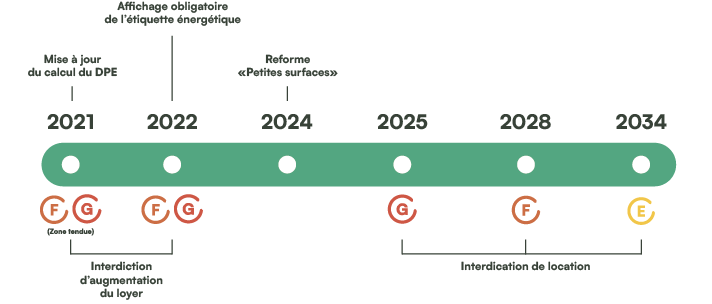
A timetable that bans letting for F- and G-rated dwellings
The initial timetable provided for a ban on letting dwellings considered as energy sieves from 1 January 2025 for properties rated G, from 1 January 2028 for properties rated F, and 2034 for dwellings rated E.
Good to know: Since 1 July 2024, a new reform has been in force for small dwellings. Dwellings of less than 40 m² can benefit from adjustments and the rating can be reviewed on the ADEME observatory website.
For dwellings intended for letting, their owners no longer have a choice. Energy renovation becomes an essential step. As a reminder, this timetable was set out in the Climate and Resilience Act of August 2021.
Works to improve your dwelling's EPC rating
Carrying out works to improve your EPC rating is possible (see our article on how to move your EPC from E to G). The EPC already suggests areas for improvement and highlights the dwelling's weaknesses in its insulation, its heating and domestic hot water systems, as well as its ventilation.
These are all points that can be improved. Moreover, to make sure that your works will help you move up an energy class on your assessment, do not hesitate to have a projected EPC carried out. This document allows our diagnosticians to incorporate your quotes or your choice of works and to run a simulation on our rating calculation software to confirm whether it is worthwhile investing in the works before they are even carried out. The projected EPC is cheaper than a certified EPC, because no visit is required and we retrieve the data from your previous EPC. You only need to provide us with the ADEME number. However, it has no legal value and does not replace the production of the official document after your works have been completed.
Works, yes, but it is more complicated when it comes to a co-ownership.
We have had this situation with some clients. Despite their good intentions in carrying out works intended to limit their dwelling's energy consumption, the projected EPC showed that the rating would remain unchanged.
Co-ownership, a subject that remains delicate for property sector professionals
Indeed, in a co-ownership, your dwelling may remain dependent on an energy-intensive heating system. Thermal bridges are often more numerous, and the question of external insulation will almost always arise.
Only the co-ownership can undertake works (sometimes colossal) to help you move your property up an energy class.
This should not discourage you from carrying out renovation works on your dwelling, but uncertainty will remain as to the decisions of your building's next general meeting.
Not all owners have the same objectives, and some may be reluctant to launch a full project if they have nothing to lose by not carrying out the works.

What about planning rules and protected buildings?
Another delicate subject. Let's imagine, in your case, that external insulation is feasible; will you be allowed to carry it out?
As Normandy diagnosticians, we deal every day with buildings made of Caen stone. It is difficult to obtain the authorisations and to be able to carry out external insulation works. This is a measure that has unsettled some of our clients, and rightly so. By carrying out a projected EPC, we were able to estimate that no energy renovation measure would make it possible to move from an F rating to an E. A hard blow that can frighten off potential buyers and property investors.
Towards a new timetable for the ban on letting energy sieves
A "relaxed" timetable is what the Prime Minister suggested during his address on 1 October 2024. A measure that had until then always been refused by previous governments.
This would give landlords of G- or F-rated dwellings more time than expected to carry out works and better anticipate these restrictions.
A relaxation of the timetable while awaiting a "simplification of the EPC"
The EPC calculation method was already revised in 2021 in order to make it more reliable for properties. The head of government has nevertheless expressed his intention to make it even simpler. For the moment, there is very little information on the details of this reform. Nevertheless, we already know that round tables between the various players in the property sector will be organised in order to meet the objectives of the Climate and Resilience Act in a more realistic way.
Key points to remember:
– Michel Barnier has announced a simplification of the EPC and, in the meantime, a relaxation of the timetable for the ban on letting energy sieves.
– Co-ownerships raise questions about the possibilities of carrying out energy renovation works.
Related diagnostic
EPC (Energy Performance Certificate)
A property project? Get a quote for your diagnostics.
Related articles

Mandatory diagnostics for student housing: what to prepare before renting for the 2026 academic year?
EPC, lead, electrical, gas, ERP, noise, asbestos, floor area: a complete overview of the diagnostics to prepare before renting a studio, a one-bed flat or a shared flat to students for the 2026 academic year, without holding up the lease signing.
Read more →
Property, EPC, energy renovation - where do we stand?
As the regulations surrounding the Energy Performance Certificate (EPC) and renovation are constantly evolving, many buyers and sellers are wondering: is it still worth investing in a property to renovate?
Read more →
The impact of energy regulations on the property market in 2024: what owners need to know to be compliant
The property market in France is undergoing a major transformation, driven by legislative developments that directly affect owners and investors.
Read more →