
Letting your property: the right steps to take regarding property diagnostics

Are you looking to let your flat or house? Before you can begin the various steps to put it on the market, it is essential to have the mandatory property diagnostics required for letting your property carried out by a professional surveyor.
Letting your property safely: what about property diagnostics?
Why is it essential to provide property diagnostics when letting your property?
From a legal standpoint, but also a practical and ethical one, it is essential to provide your future tenants with a Technical Diagnostic File (DDT) when signing the tenancy agreement. This file will include the various mandatory diagnostics depending, for example, on the type of dwelling you are offering and its age.
Indeed, bear in mind that not all properties are equal! Today, a property’s age or its energy rating does not place it in the same position in the eyes of the law, and therefore does not entail the same obligations on the landlord’s part.
Note that, should you fail to comply, you could face legal penalties or a request for a rent reduction from your tenant. Learn more in this article about the mandatory diagnostics for letting.
Compiling the Technical Diagnostic File (DDT) with all the mandatory diagnostics for letting
First of all, it is important to call on a certified surveyor to ensure you receive a clear service and reliable property diagnostics. At RITMODiag, we provide qualified and recognised experts to deliver the best service in the shortest possible time.
You can prepare your dwelling as best you can for the surveyor’s visit to make their work easier and save time. To do so, remember to clear access to the various meters, consumer units, boilers and other installations. If you have any documents useful for carrying out the diagnostics (plans, works invoices, insulation certificates, previous diagnostics, etc.), don’t forget to have them to hand at the appointment.
The list of diagnostics to provide to the tenant and their purposes
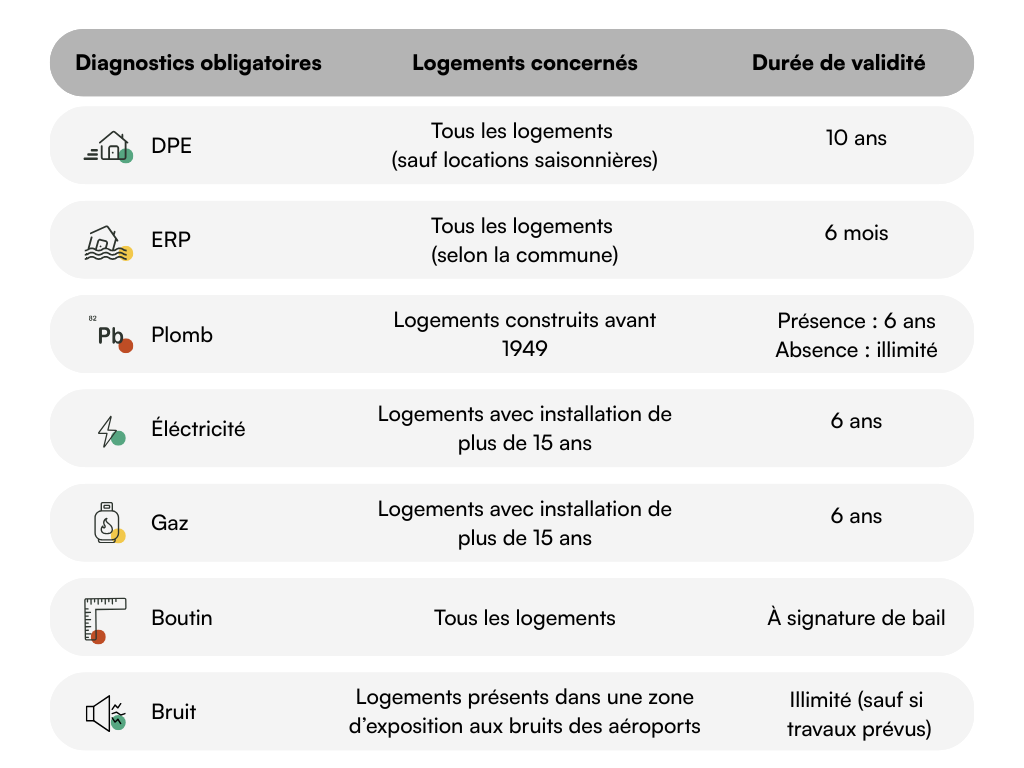
- EPC (Energy Performance Certificate)
The energy performance certificate (EPC) is a diagnostic that assesses your dwelling’s energy consumption as well as its greenhouse gas emissions. Dwellings are thus rated from A to G.
If you plan to carry out works (insulation, changing the heating, extending the floor area, etc.), you will of course need to have a new EPC drawn up.
It is also worth noting that since 2025, dwellings rated G may no longer be let.
- ERNMT/EPR: Natural and technological risks
To inform the tenant about natural, technological and seismic risks, soil and mining pollution, etc. concerning the geographical area where the dwelling is located.
If the risk prevention plan is amended or the prefectural zoning changes, the diagnostic must be redone.
- Lead diagnostic
To detect the presence of lead in paint, for example, and thus prevent lead
poisoning.
Works altering or affecting the coatings may trigger the
need for a new diagnostic.
- Electrical diagnostic
To ensure the safety of the internal electrical installations and thus prevent the risk of fire or electrocution.
A new diagnostic must be carried out when works are undertaken and the electrical system is fully renovated.
- Gas diagnostic
To ensure the safety of the gas installation, in particular the pipework, ventilation and
various appliances.
A new diagnostic must be carried out when works are undertaken and the gas
equipment is fully renovated.
- Noise diagnostic
For a dwelling located in an aircraft noise zone according to the Noise Exposure
Plan (PEB).
If the PEB is revised or an airport is built nearby, the diagnostics must be
redone.
- Loi Carrez / Loi Boutin measurement
To provide information about the actual habitable floor area.
If works altering the habitable floor area are carried out (partitioning, extension, etc.),
this triggers the need for a new diagnostic.
How to present and include your diagnostics in your rental file?
It is fairly simple to present all the diagnostics to your future tenants. You can compile what is known as a DDT: a Technical Diagnostics File. This is a single document that will be appended to the tenancy agreement when you have the lease signed.
You can also make this DDT available beforehand, during viewings, to showcase your property to tenants as effectively as possible. Indeed, this will help you appeal to tenants who are particularly mindful of energy performance. As explained above, the DDT will contain various property diagnostics depending on the nature of the property, its geographical location and the building’s construction date. You can provide a summary of certain information (habitable floor area, energy performance and risks) on the first page of this file.
This DDT can be provided digitally (PDF) or as a paper copy to be handed over in person.
Don’t hesitate to get in touch with our RITMODiag experts with any questions; we will be delighted to support you as best we can with your letting project.
The risks you run with an incomplete DDT
When you decide to let your property, failing to present a complete DDT can lead to financial risks or legal penalties. This is not something to take lightly!
Indeed, if the tenant notices that one of the mandatory diagnostics is missing, they are entitled to challenge the validity of the tenancy agreement. In the event of a dispute, for instance due to a health issue or an accident linked to a faulty installation or a hidden defect, the absence of a diagnostic will count against you.
From a financial standpoint, the tenant is entitled to request a rent reduction, or even damages for « non-respect of the duty to inform ». Should urgent works be required, these could fall to you if a diagnostic could have anticipated them.
Bear in mind that, beyond enhancing the value of your property, some of the diagnostics included in the DDT are also there to protect you in the event of a claim. They provide proof of compliance and can enable your insurer to offer compensation should the dwelling suffer damage.
With the help of our property surveyors, the right steps to take when letting your property
Bear in mind that providing property diagnostics means complying with the law, protecting yourself as a landlord, protecting the tenant and enhancing the value of your property. You thereby adopt a responsible approach, transparency towards your tenant and prevention against potential disputes.
Before starting the various diagnostics for letting your property, you can begin by gathering the diagnostics you already have and checking their validity. Feel free to use the table above to find out more.
Remember that any change to the dwelling (works, extension, electrical modification, replacement of heating systems, etc.) may require new diagnostics to be carried out.
To make your life easier, start the property diagnostics process even before publishing your listing. Because certain diagnostics must be mentioned in the listing, on pain of penalties.
Finally, to optimise your EPC so as to better let your property, consider reducing your energy losses by renovating the insulation and windows and changing the heating. Do not keep the obsolete installations in your house or flat, and remember to keep the invoices for all these installations to prove them to the surveyor.
An optimised EPC means a higher property value and greater appeal!
Surveyors who listen to your property letting project
Contact RITMODiag now to arrange an appointment with one of our experts. We will support you as quickly as possible to carry out all the property diagnostics. You can contact us now by phone on 02 31 15 64 88.
Our property surveyors travel to you and offer their services
in the shortest possible time.
Related diagnostic
EPC (Energy Performance Certificate)
A property project? Get a quote for your diagnostics.
Related articles

Mandatory diagnostics for student housing: what to prepare before renting for the 2026 academic year?
EPC, lead, electrical, gas, ERP, noise, asbestos, floor area: a complete overview of the diagnostics to prepare before renting a studio, a one-bed flat or a shared flat to students for the 2026 academic year, without holding up the lease signing.
Read more →Becoming a self-employed property surveyor – RITMODiag franchise
In France, the property survey sector is experiencing continuous growth. Surveyors carry out mandatory inspections, essential steps before any sale, letting, building demolition or works.
Read more →
ERP and ENSA: aircraft noise expertise integrated into your property surveys
When selling or letting a property, you are required to provide property surveys to ensure transparency for future buyers or tenants.
Read more →