
The ERP: the survey you're bound to forget before your sale

Do you think you've planned everything for your property sale? The EPC has been approved, the asbestos survey is in the bag, the electrical survey too… And yet, chances are you're still missing an essential survey in your DDT (Technical Survey File).
Have you thought about the ERP (risks and pollution statement)? This short document of just a few pages is too often overlooked when selling a house.
A closer look at this forgotten survey.
What is the ERP survey (risks and pollution statement)
The ERP is something of the black sheep in the property surveys family. Unlike the EPC or the lead survey that everyone talks about, we tend to forget the risks and pollution statement. It gets less attention, yet it is just as mandatory for certain sales!
Until 2018, it was called the ERNMT (État des Risques Naturels, Miniers et Technologiques, or Statement of Natural, Mining and Technological Risks). Then the ERP was renamed and evolved to include new parameters.
So what is the purpose of the ERP? It is above all to inform the buyer investing in certain areas, or the tenant, about the property's surroundings and the risks to which they could be exposed.
Here is a brief overview of what an ERP can reveal:
- Natural risks: floods, earthquakes, landslides, avalanches, forest fires, volcanic eruptions, etc.
- Technological risks: proximity to SEVESO-classified industries, nuclear sites, dam failure, transport of hazardous materials,
- Mining risks: the presence of underground cavities, former mining operations with a risk of collapse, etc.,
- Radon zoning: exposure to the radioactive gas present in certain soils,
- Soil pollution: land that has hosted polluting industrial activities,
- Clearing obligations: in areas exposed to fires.
The reflex to build into your Technical Survey File (DDT): the ERP
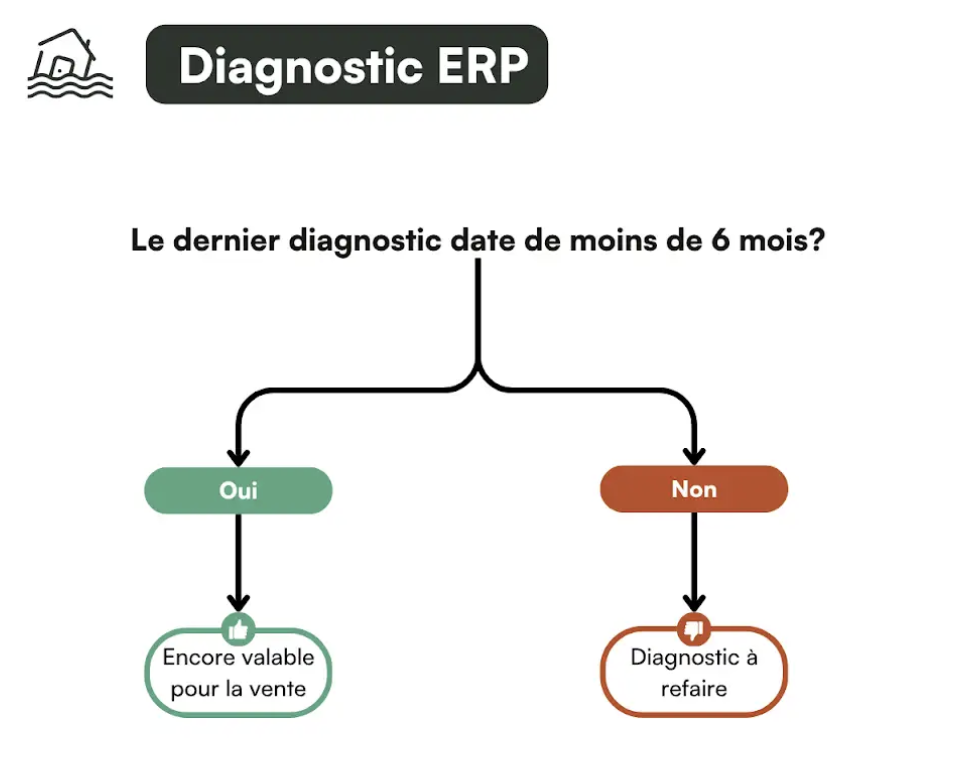
The Technical Survey File (DDT) is a document that brings together all the mandatory surveys for the sale of a house. The ERP must be included in it, just like the other property surveys, depending on the property's location. But it has one small peculiarity: it is only valid for 6 months!
This is indeed much shorter than most surveys. And this short duration may partly explain why many sellers get caught out and forget the ERP in their DDT.
Between the initial listing and the final signing at the notary's, this survey can become out of date, so be careful to keep it up to date to finalise your property transaction!
The ERP, mandatory under certain conditions
The obligation to produce a risks and pollution statement depends on the location of your property. For example, if your home is located in:
- An area covered by a Technological Risk Prevention Plan (PPRT),
- An area covered by a Foreseeable Natural Risk Prevention Plan (PPRNP),
- An area covered by a Mining Risk Prevention Plan (PPRM),
- An area under study for the development of a technological, natural or mining risk prevention plan,
- An area with a possibility of an earthquake of level 2 to 5,
- An area with a level 3 radon potential,
- An area affected by coastal erosion, defined by a local urban plan (PLU) for example,
- An area subject to clearing obligations,
To find out whether your home is affected, you can consult the Géorisques website. Simply by entering your property's address, you will immediately know whether the ERP is mandatory or not for a property sale.
Your town hall or prefecture can also provide you with information.
⚠️All properties are affected: houses, flats, land, garages, commercial premises, etc.
How and by whom is your ERP produced?
Good news! The ERP is the only property survey that you may be able to carry out yourself.
That's right: by going to the Service Public website under the 'Help completing the risks and pollution statement ' section, you can produce your own risks and pollution statement. It is a relatively simple form to complete.
With all the documents to hand, it will take you between 15 and 30 minutes, and it is completely free!
The second option is to call on a professional property surveyor who will produce your ERP during their visit to carry out the other property surveys.
This is the safe option, which allows you to make sure there will be no errors in completing it. You protect yourself in the event of a dispute and you are covered by the surveyor's professional insurance.
The consequences of a missing ERP
If you have not provided a risks and pollution statement, you could say you're playing with fire (no pun intended). What do you risk if the ERP is missing?
In the case of a house sale or flat sale
The buyer may decide to take the matter to court to request the cancellation of the sale. They may also demand a reduction in the sale price.
As the seller, you may be held civilly liable for a hidden defect, and the sale will be cancelled without penalty for the buyer.
In the case of a house letting or flat letting
The tenant may request the cancellation of the lease and claim damages. A judge may also grant a reduction in rent.
As the owner, you risk a fine of up to 300,000 euros and a 2-year prison sentence.
Furthermore, if you have used an estate agent, they may also be held liable.
Suffice to say, the game isn't worth the candle (more fire… we promise we're not doing it on purpose!).
But why is the ERP the forgotten survey?
How is it that many people, during a property transaction, forget to carry out the ERP?
First of all, as we mentioned above: its ultra-short validity period. A sales process can sometimes stretch over more than 6 months, and an ERP produced at the start of the sale can end up expired by the time of signing! Watch out for that.
The fact that the ERP can potentially be free is also one of the reasons. It's surprising but true! Paradoxically, the fact that it can be produced free of charge by yourself makes this survey less visible than other property surveys.
Another reason we can mention: many surveys apply to all properties (like the EPC, for example), whereas the ERP is only mandatory in certain areas. Being specific, this can cause confusion.
Finally, the lack of awareness about this survey is also to blame. That's why, at RITMODiag, we're telling you about it!
Best practices to avoid forgetting the ERP in your sales process
RITMODiag goes back over the habits to adopt so you remember to carry out the ERP:
- Check your property's area on the Géorisques.gouv.fr website right from the start,
- Include the risks and pollution statement in the package of property surveys you need to carry out, and talk to your surveyor about it,
- Keep an eye on the validity date of your survey, and plan its renewal ahead if needed,
- Include a mention of the ERP in your listing alongside the other surveys; this will reassure potential buyers,
- Inform buyers from the very first viewing: here, the law requires you to provide the information on risks from the potential buyers' very first viewing.
With this little checklist, you're sure never to forget the ERP again!
The future changes to this property survey
Like many surveys, the ERP is no exception and has not finished evolving. Several changes are expected with this survey!
This may involve changes to the areas (expansion following climate change, new risk areas, etc.). When it comes to the environment, changes can be rapid and far-reaching!
Furthermore, the regulations may add new risks based on other environmental parameters. For example, coastal erosion came into force in 2023! That's very recent.
Other changes are under discussion, such as extending the validity period to 1 year, or the full digitalisation of this survey to make access to the data easier.
Be warned, however: in the face of oversights and breaches, the laws could tighten and increase the penalties for a missing ERP!
Trust our certified experts for all your property surveys
As you will have gathered, the ERP is far from being a trivial survey! To secure the sale of your house and make sure you don't forget the risks and pollution statement, call on certified surveyors!
At RITMODiag, we leave nothing to chance and we offer you our advice and visits as soon as possible. Our teams support you through all your procedures and in carrying out your property surveys.
Contact our advisers today to put together a complete DDT!
Related diagnostic
EPC (Energy Performance Certificate)
A property project? Get a quote for your diagnostics.
Related articles

Mandatory diagnostics for student housing: what to prepare before renting for the 2026 academic year?
EPC, lead, electrical, gas, ERP, noise, asbestos, floor area: a complete overview of the diagnostics to prepare before renting a studio, a one-bed flat or a shared flat to students for the 2026 academic year, without holding up the lease signing.
Read more →
Energy performance: an essential criterion when selling a property
Energy performance is now becoming a decisive criterion for the success of a property transaction. The energy performance certificate, or EPC, is no longer seen as a constraint but as a selling point that will influence the value of your property and
Read more →
Property diagnostics and energy renovation: Maximising the value of your property in 2024
The rise in energy costs and the growing interest in the environment make optimising the energy performance of properties essential.
Read more →